.svg)
How to scale SEO content for a SaaS without a full content team
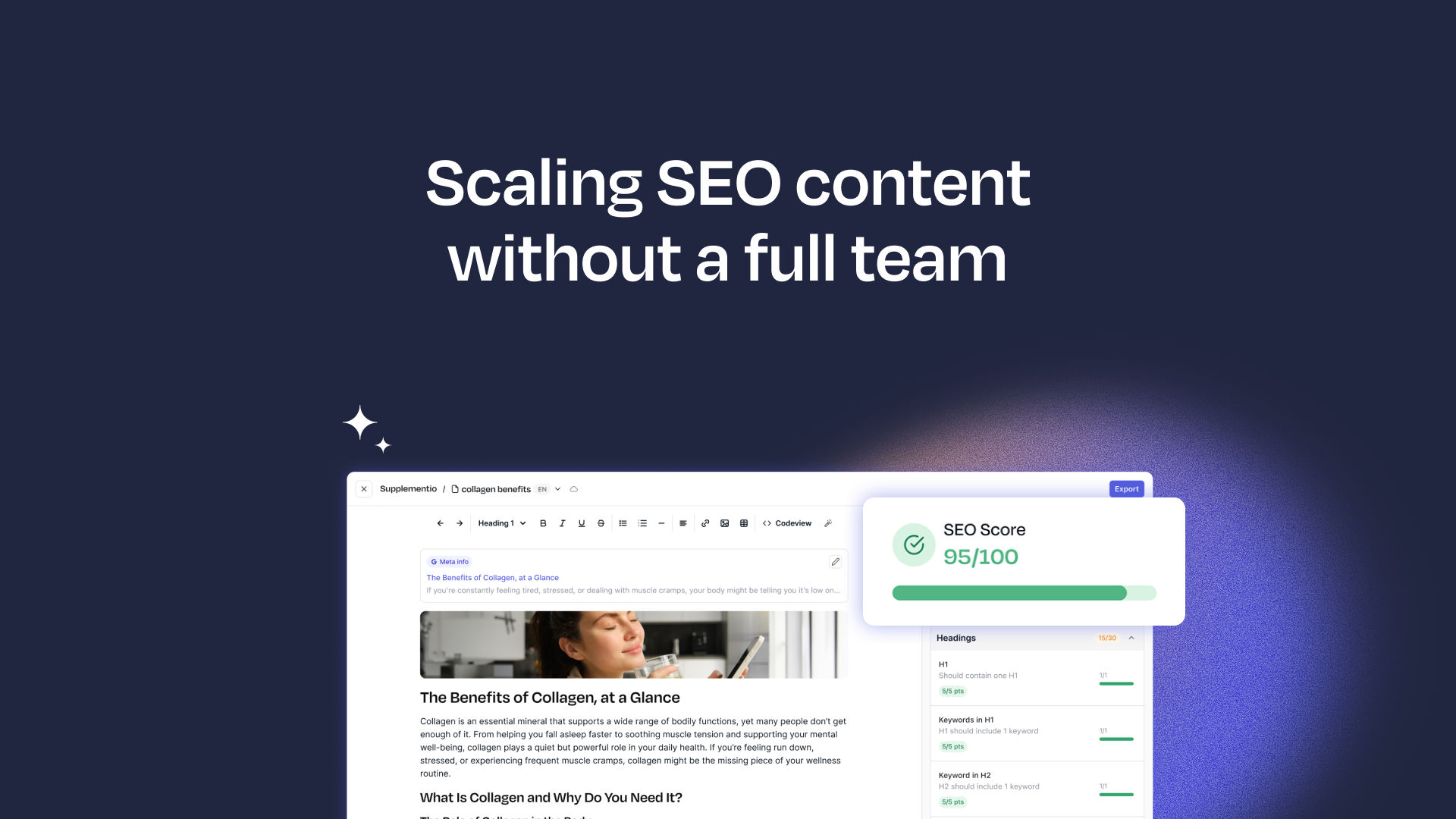
How to scale SEO content for a SaaS without a full content team
Scaling SEO content for a SaaS company often feels impossible when you lack a dedicated, full-time content team. But with smart workflows, targeted strategies, and modern generative AI tools, you can build a high-performing organic growth engine. This guide breaks down the exact frameworks and technical processes required to produce authoritative, conversion-focused content at scale without burning out your existing resources.
Understanding SEO content that actually drives SaaS growth
The search landscape has fundamentally shifted. Traditional Google rankings are no longer the sole driver of organic traffic. Today, B2B buyers rely heavily on AI-powered answers to research software solutions, compare features, and make purchasing decisions. To capture this modern search intent, your SEO content must evolve into Generative Engine Optimization (GEO). We built Blym to solve this exact challenge: our platform optimizes content for both traditional Google rankings and direct AI citations from ChatGPT and Perplexity. This dual approach keeps your SaaS brand visible wherever your target audience is searching. 🎯
High-converting SEO content requires a balance of technical precision, deep domain expertise, and strategic formatting. When operating with a lean team, every piece of published content must serve a specific revenue-generating purpose. You cannot afford to publish generic, top-of-funnel fluff that generates empty traffic. Instead, successful SaaS content marketing focuses on answering complex B2B queries with authoritative data, clear product positioning, and actionable insights. By focusing on high-intent queries and structuring your data clearly, you can punch above your weight class and compete with enterprise SaaS companies that employ dozens of writers. The goal is to create a content strategy that maximizes output quality while minimizing the manual hours required for research, drafting, and technical optimization.
Strategic foundations: Building content that converts without burning out
A scalable content engine requires a ruthless prioritization framework to make sure limited resources generate maximum ROI.
Prioritizing topics and keywords that move the needle
Stop chasing high-volume, top-of-funnel vanity metrics. For a lean SaaS team, prioritizing topics and keywords that move the needle means focusing on Bottom-of-Funnel (BoFu) and Middle-of-Funnel (MoFu) queries. Target keywords with high commercial intent, even if the search volume is under 100 searches per month. A target keyword with 50 monthly searches that converts at 5% yields more revenue than a 5,000-volume keyword converting at 0.01%. Look for comparison queries, alternative searches, and specific use-case templates. Filter your keyword research for terms with a Keyword Difficulty (KD) score below 40 to secure faster rankings.
Understanding search intent for SaaS buyers (not just browsers)
Understanding search intent for SaaS buyers requires analyzing the exact stage of the buyer's journey. B2B buyers don't just want definitions; they want solutions to specific operational bottlenecks. Aligning your content with the correct intent is critical for driving qualified traffic.
Defining clear content goals that align with revenue objectives
Defining clear content goals that align with revenue objectives prevents your team from creating SEO content in a vacuum. Every blog post or landing page must have a quantifiable target. Instead of aiming for "more traffic," set specific parameters: "Generate 15 demo requests per quarter from this specific product guide." Track metrics like Time-to-Value (TTV) for users who read your documentation, or the percentage of organic visitors who transition into Marketing Qualified Leads (MQLs). By tying content SEO directly to pipeline velocity, you justify the resources spent on content creation and keep your lean team focused only on high-impact deliverables that improve the bottom line.
Streamlining content creation workflows that work
Efficient production relies on repeatable systems that minimize friction between ideation and publication.
Leveraging existing expertise within your team
Your internal team is a goldmine of proprietary data and unique insights. Leveraging existing expertise within your team means extracting knowledge from product managers, sales reps, and customer success managers. Implement a 15-minute monthly interview process where a writer records a quick Q&A with an internal Subject Matter Expert (SME). Sales calls recorded on platforms like Gong can be transcribed and transformed into highly relevant blog posts addressing real customer objections. This approach injects original experience into your content, directly satisfying Google's E-E-A-T guidelines without requiring hours of writing from your technical staff.
Using AI and automation tools without sacrificing quality
The biggest mistake lean teams make is relying on a single, generic AI prompt to write entire articles. Using AI and automation tools without sacrificing quality requires a sophisticated, multi-model approach. We built Blym's proprietary AI engine over 12 months of research to solve this exact problem by orchestrating across four world-class AI providers to choose the optimal model for each specific task. Whether it's outlining a complex topic, drafting technical paragraphs, or optimizing semantic keywords, this dynamic routing delivers superior, nuanced results compared to single-model competitors. This allows your small business to produce expert-level SEO content at scale while maintaining strict quality control. 🚀
Developing content templates and frameworks that scale
Staring at a blank page destroys productivity. Developing content templates and frameworks that scale reduces drafting time by up to 40%. Create standardized structures for your most common content types:
- Listicles: Introduction, criteria for selection, 5-7 numbered items with pros/cons, and a clear CTA.
- How-to guides: Problem statement, prerequisites, step-by-step numbered instructions, and expected outcomes.
- Competitor comparisons: Feature matrix table, pricing breakdown, ideal user profiles, and a neutral verdict.
Standardizing these formats creates consistency across your site and allows anyone on your team to plug in information quickly to create quality content.
Managing outsourced content and freelancers effectively
When internal capacity maxes out, external help becomes necessary. Managing outsourced content and freelancers effectively requires comprehensive content briefs. A standard brief should include the target keyword, 3-5 secondary keywords, the exact search intent, a detailed H2/H3 outline, and links to 2-3 internal resources for citation. Establish a strict QA checklist that verifies technical accuracy, brand voice alignment, and formatting standards before publication. By providing freelancers with rigid parameters, you eliminate endless revision cycles and get final output that aligns perfectly with your SaaS marketing strategy.
Optimizing for impact: Technical efficiency that matters
Technical optimization makes sure your high-quality writing actually gets crawled, indexed, and ranked by search engines.
Essential on-page optimization practices that actually work
On-page SEO is the bridge between great writing and high visibility. Essential on-page optimization practices that actually work go far beyond basic keyword placement in the title tag. You must optimize for semantic relevance, entity extraction, and comprehensive topic coverage. We designed Blym to automate this heavy lifting; our platform delivers 85+ SEO scores by extracting real-time ranking factors and semantic terms from top-performing competitors. By naturally integrating these LSI (Latent Semantic Indexing) keywords into your headers, meta descriptions, and body paragraphs, you signal deep topical authority to search engines without resorting to unnatural keyword stuffing.
Strategic internal linking for building authority
A siloed blog post rarely ranks well. Strategic internal linking for building authority requires a deliberate "hub and spoke" architecture. Group your content into core topic clusters. For example, a comprehensive guide acts as the hub, while specific articles act as spokes. Every spoke must link back to the hub using exact-match or highly relevant anchor text. This structure distributes PageRank efficiently across your domain, helping newer articles rank faster by leveraging the established authority of your older, high-performing pages. Aim for at least 3-5 internal links per 1,000 words to improve site navigation and user experience.
Structuring content for both readers and search engines
Modern users scan before they read. Structuring content for both readers and search engines means prioritizing scannability and technical markup. Use short paragraphs (maximum 3-4 sentences) to let the text breathe. Implement descriptive H2 and H3 tags that clearly outline the article's hierarchy. For search engines, deploy structured data (Schema markup) such as FAQPage or Article schemas to increase your chances of securing a featured snippet in the SERP. Include bulleted lists, bolded key terms, and relevant image assets to break up walls of text. This dual-optimization approach reduces bounce rates while giving search engine crawlers clear contextual signals about your content's value.
Amplifying reach and performance
Creating the content is only half the battle; maximizing its lifespan and visibility guarantees a higher return on your investment.
Repurposing and distributing content for maximum impact
A lean team cannot afford to publish an article and forget it. Repurposing and distributing content for maximum impact multiplies your output. A single 2,000-word blog post should be fractured into multiple assets: extract three key statistics for LinkedIn text posts, convert a comparison table into a carousel graphic, script short videos for YouTube, and summarize the core methodology for your email newsletter. This omnichannel approach keeps your target audience interacting with your insights across different mediums, driving referral traffic back to the original SEO content without requiring net-new writing.
Measuring performance with metrics that matter to your business
Vanity metrics like raw pageviews can be misleading. Measuring performance with metrics that matter to your business requires tracking the entire user journey. Monitor your organic Click-Through Rate (CTR) in Google Search Console; an increase from 2% to 4% effectively doubles your traffic without needing higher rankings. Track keyword movement for high-intent BoFu terms, and use tools like Google Analytics 4 (GA4) to measure event conversions, such as newsletter signups, lead magnet downloads, or direct software trials originating from specific blog posts.
Maintaining and updating evergreen content efficiently
Search engines prioritize fresh, accurate information. Maintaining and updating evergreen content efficiently prevents organic decay, as outdated content can lose up to 20% of its traffic over six months. Schedule quarterly audits to refresh outdated statistics, fix broken links, and expand sections based on new user questions. When updating content using generative tools, maintaining a human touch is critical. We engineered Blym to solve this: our platform achieves 3x lower AI detectability while maintaining natural readability. This means your refreshed articles remain engaging, authoritative, and safe from search engine algorithm updates targeting low-effort, mass-produced AI spam. ✅
Conclusion: Smart strategies for scaling your SaaS content
Scaling SEO content without a massive team is entirely achievable when you combine strategic focus with the right technological approach. By prioritizing high-intent topics, streamlining your workflows with multi-model AI, and rigorously optimizing for both traditional search engines and modern AI assistants, your SaaS can build a formidable organic presence. Remember that consistency and quality will always outperform sheer volume. Focus on answering your target audience's most pressing questions with technical precision and clear, actionable insights. As the search landscape continues to evolve toward generative answers, adopting a dual SEO and GEO strategy will keep your brand the authoritative voice in your industry, driving sustainable growth and qualified pipeline for years to come.
Frequently asked questions
Here are the most common questions about building and scaling an organic search strategy for software companies.
How do you write SEO content that converts?
To write SEO content that converts, focus on bottom-of-funnel search intent and address specific customer pain points. Integrate clear calls-to-action (CTAs), showcase your product as the logical solution, and back up your claims with quantifiable data and case studies.
What are the 4 types of SEO optimization?
The four main types of SEO optimization are On-page SEO (content and keywords), Off-page SEO (backlinks and brand authority), Technical SEO (site speed, architecture, and schema), and Local SEO (optimizing for location-based searches, though less relevant for global SaaS).
Can a beginner handle SEO for their SaaS?
Yes, a beginner can handle SEO by focusing on the fundamentals: understanding their target audience, answering questions clearly, and using intuitive tools. Platforms that automate technical optimization and semantic keyword integration make it possible to achieve professional results without deep technical expertise.
How can a small SaaS team scale content production effectively?
A small team can scale production by leveraging subject matter experts, utilizing standardized templates, and adopting advanced AI writing platforms. Repurposing a single piece of content across multiple channels also maximizes output without requiring additional writing resources.


I’m the Founder & CEO of Blym AI, a GEO & SEO software designed to help companies create on-brand content that ranks on Google and LLMs like ChatGPT.
I specialize in search-driven content strategy, with a strong focus on SEO, GEO, and AI-assisted writing.
On a daily basis, I research AI writing systems, work closely with customers, and continuously improve Blym to match real-world content and search requirements.
Blym is built with humans at the center. It doesn’t aim to replace expertise, but to help industry experts express their knowledge clearly and efficiently, turning it into high-quality, flexible content that performs in modern search environments.